Before answering a single question, WashU donor Jack MacDonough flips the script on the writer interviewing him. “I’ve got news for you,” he says after striding into a conference room. “I get to ask you questions first.”
MacDonough’s genuine interest in people — and the projects he supports — defines his philanthropy, including his recent commitment of $750,000 over three years for promising research led by WashU Medicine neurology and radiology professor Scott Norris, MD. The gift, made through With You: The WashU Campaign, enables Norris’ team to maintain critical momentum in its efforts to advance new treatments for dystonia, an often disabling but little understood movement disorder.
“Without this funding, our ability to build on the preliminary data we have gathered would have been delayed by at least a year or two,” Norris says. “Jack’s curiosity and engagement are a breath of fresh air. And his willingness to accelerate science is a testament to his personality and desire to improve human health.”
Personal connection
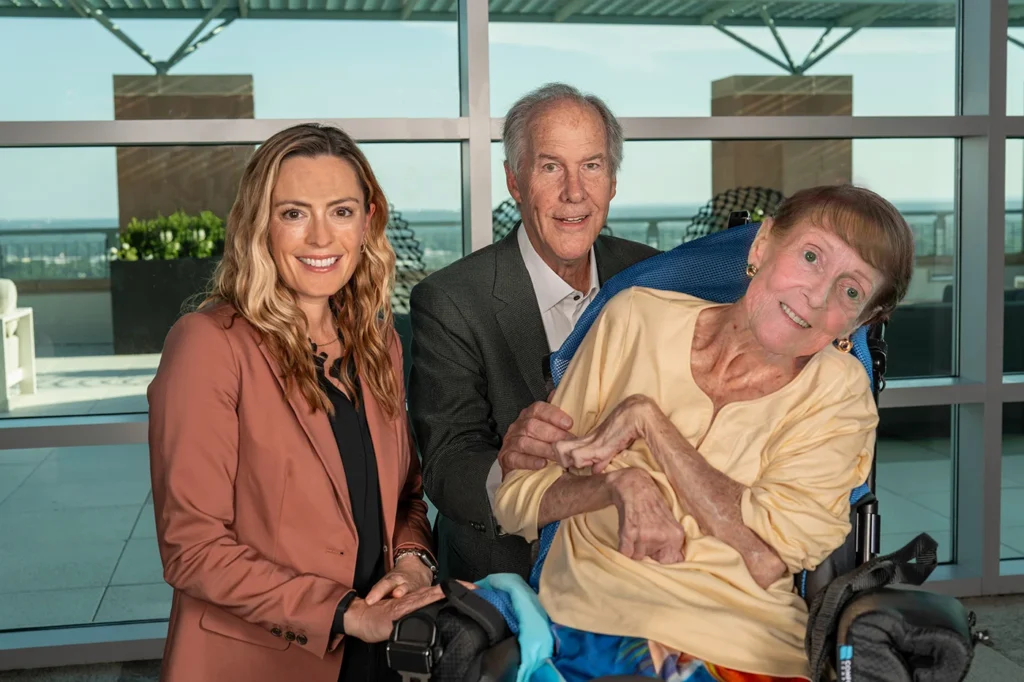
Dystonia hits close to home for MacDonough, former CEO of Miller Brewing Co., now part of Molson Coors Beverage Co. His wife of 45 years, Kathy, MA ’76, experiences widespread involuntary muscle contractions associated with the neurological disorder, which affects her mobility and speech.
In gratitude for the treatment Kathy received for the condition from WashU Medicine’s Program in Physical Therapy, the couple endowed a scholarship last fall for students in the program. Jack subsequently attended several university events focused on neuroscience research, which opened his eyes to WashU’s global leadership in the field. Then he was introduced to physician-scientist Norris, chief of the Department of Neurology’s Section of Movement Disorders, who uses cutting-edge MRI and PET imaging techniques to unravel the mysteries of dystonia and related movement disorders.
“He explained his research to me, and I was impressed,” Jack says. “It was better than listening to Google. I asked him if his work had been affected by a lack of federal support, and he said yes.”
Dystonia is classified as a rare disease, and National Institutes of Health grants for these types of conditions has become more difficult to secure, Norris says. Without the MacDonough gift, his team’s progress would have stalled. “It’s allowing us to leverage the success we’ve had and hasten discovery for patients who struggle with reduced quality of life,” he says.
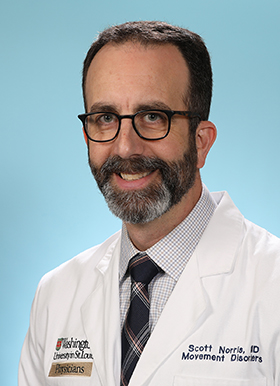
The funding supports two areas of dystonia research. Employing a pioneering MRI method developed at WashU Medicine known as precision functional mapping, Norris’ team has found the brain circuits driving dystonia symptoms vary for individual patients. The work holds promise for improving the accuracy of neuromodulation therapy, which uses electrical impulses to disrupt the abnormal signals that cause muscle contractions.
The team also aims to elucidate the role of the brain chemical acetylcholine in dystonia using combined MRI and PET imaging to map abnormalities in its signaling pathway. The gift will allow them to develop a PET tracer to evaluate the involvement of a specific receptor that carries messaging regarding muscle movement.
“We hope to determine how the receptor functions abnormally in dystonia and whether we can target it with drugs,” Norris says. “A dystonia-specific medication would be a game changer for patients.”
This research requires highly skilled scientists capable of applying the advanced technology available at WashU Medicine. A portion of the MacDonough gift will enable the university to attract and retain talented staff members.
“People are a critical resource in science,” Norris says. “By investing in them, the MacDonoughs are supporting more than specific projects. They are also building the foundation for future breakthroughs.”
Nurturing talent
Knowing their giving has an impact is a key driver for Jack. “I used to write checks to organizations, but I never knew where the money went,” he says. “I don’t do that anymore. I like to be involved. I want to know the people and be part of the team.”
It was Kathy’s idea to engage with WashU after the couple moved their primary residence to St. Louis in 2015. They had lived in the area previously during Jack’s 15-year tenure with Anheuser-Busch, where he rose to the position of executive vice president of marketing for the brewer’s international unit and Kathy worked as a teacher and marketing researcher. A decade later, multiple university schools and programs have benefited from their philanthropy.
“People are a critical resource in science. By investing in them, the MacDonoughs are supporting more than specific projects. They are also building the foundation for future breakthroughs.”
Scott Norris, MD
Physical therapist Theresa Notestine, DPT, a clinical practice manager for the Program in Physical Therapy, met the MacDonoughs about six years ago when Kathy was referred to her for treatment. After Kathy’s therapy ended, Notestine developed a friendship with the couple. She steered physical therapy students to Jack, who pays them to help Kathy with stretching exercises in their home. Jack has become close with the students as well.
“I give them advice on interviewing, career choices, and purchase decisions,” Jack says. “Learning about the challenges of financing their schooling led directly to our decision to support scholarships.”
Beyond their endowed scholarship, the MacDonoughs recently established an annual scholarship for the Program in Physical Therapy, and both are named in honor of Notestine. And they make yearly gifts through the Barnes-Jewish Hospital Foundation to purchase equipment for clinics managed by her and other WashU physical therapists.
“I feel incredibly passionate about the work I do, and it means so much to me to know they understand its value and are willing to advocate for it,” Notestine says. “We can all learn from their generosity, their positive attitude, and the way they approach the world.”
The MacDonoughs also support WashU’s Institute for School Partnership, Gephardt Institute for Civic and Community Engagement, and Sam Fox School of Design & Visual Arts, where they provide funding to further the practice of a faculty member who specializes in photography. Jack himself is an accomplished commercial and art photographer whose images have been collected by individuals and organizations around the globe. Fourteen of his photographs were recently selected for permanent display at WashU Medicine’s new physical therapy clinic in Sunset Hills, Missouri.
While Jack jokes that he gives to WashU to get baseball caps and other university swag, he admits it’s really about empowering talented people. He counsels other donors to engage with WashU gift officers to identify opportunities that excite them.
“Explain what your interests are,” he says. “Don’t make them guess. If you have patience with the process, you may end up getting to know students and faculty members who stimulate you intellectually and open new worlds to you.”
Learn more about how you can support WashU Medicine’s efforts to promote healthier lives through research and patient care.