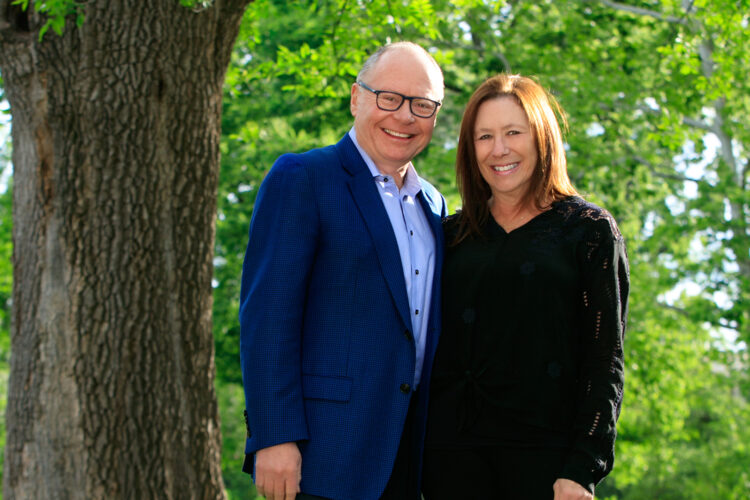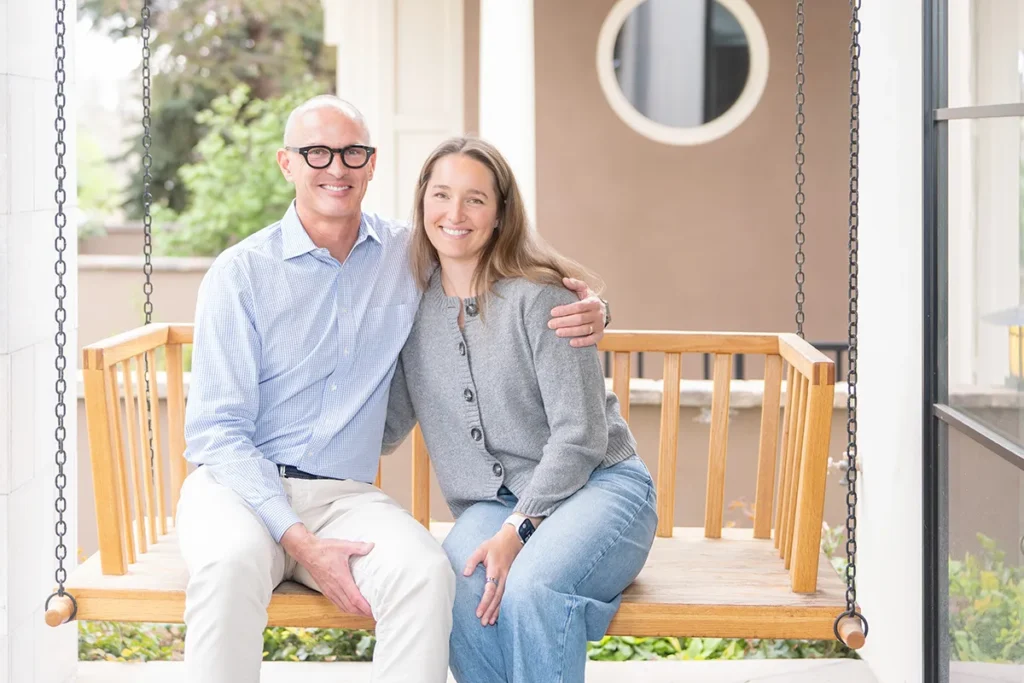
WashU is in the DNA of the Towle family. As a child, Chris Towle, MBA ’98, attended functions at the university’s faculty club with his grandfather, Joseph W. Towle, a professor of management at Olin Business School from 1954 to 1975. Chris’ daughter, Hannah Towle Barthelmess, BSBA ’16, also earned a degree from Olin, and the family has supported scholarships at the business school for many years.
The Towle family’s engagement with WashU grew last year after the university launched the Food and Agriculture Research Mission (FARM), which aims to drive impactful research and scholarship at the nexus of public health, food, and agriculture. The initiative — housed in the new Andrew M. and Jane M. Bursky School of Public Health — resonated with Denver-based Chris and Hannah, who serves as managing partner of a nearly 1,000-acre farm near DeKalb, Illinois, that has been in their family since the 1830s.
Recognizing an alignment of goals, the Towles recently pledged $500,000 in spendable funding through their family foundation to establish two postdoctoral fellowships for FARM. The fellows will expand the initiative’s interdisciplinary research agenda and its capacity to deliver practical solutions for intractable problems.
“We have been looking for ways for our foundation to become more involved in sustainable agriculture,” Hannah says. “We believe a key issue facing our country and our world is the need to feed a growing population in a way that enhances human health. WashU is on the same page. Frankly, it was an easy decision to invest in FARM.”
Catalytic gift
The Towles’ gift fuels WashU’s efforts to promote healthier lives and flourishing communities through With You: The WashU Campaign. It also strengthens the Bursky School of Public Health’s ability to achieve those aims through FARM.
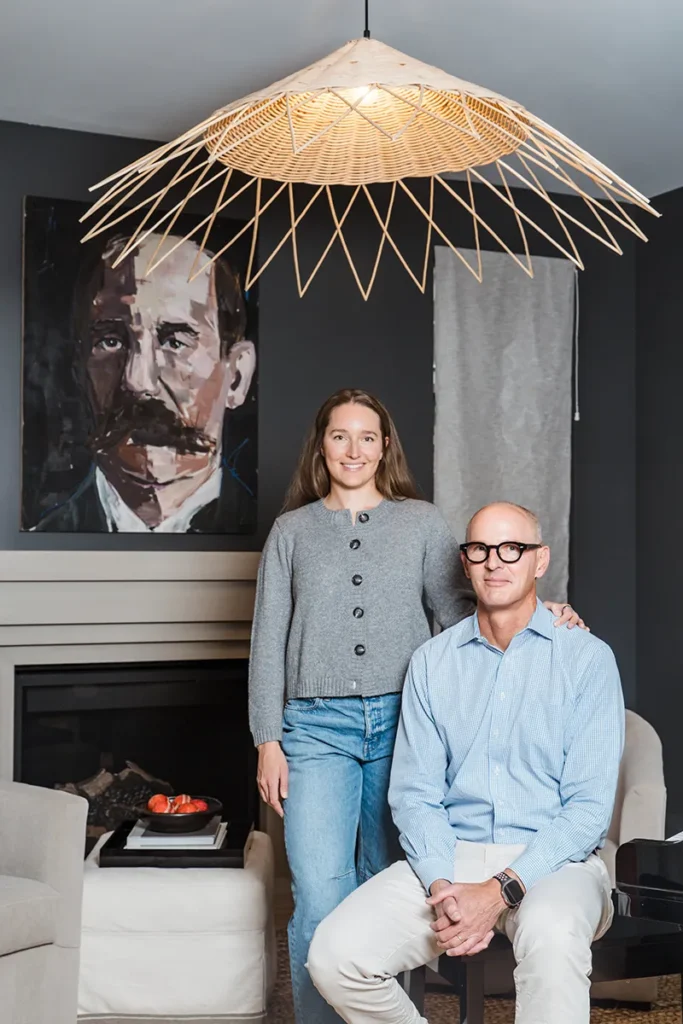
“The Towle Family Postdoctoral Fellows will be catalytic,” says Morven McLean, inaugural director of FARM and executive director of networks and innovation at the school. “These individuals will bring energy, intellectual agility, and drive to advance research and partnerships that are foundational to FARM’s success.”
Recruitment for the two two-year positions is underway, with a projected start date of summer or early fall. Candidates must have a doctoral degree in public health, nutrition, epidemiology, health policy, agricultural science, or a related area. More important than their field of study, McLean says, is their commitment to working across disciplines and with regional partners as they hone their interests and expertise.
Their research also must be “demand-driven,” McLean adds. “It should address needs identified by farmers, food producers, or other actors in the value chain. Real-world impact is not an afterthought for FARM. We want to produce durable change.”
For example, the success of investigations focusing on the environmental effects of modern agriculture, supply chain inefficiencies, or chronic disease linked to diet would be measured by its influence on policy, food waste, or health outcomes.
Beyond research, the fellowships will provide a springboard for early-career scientists who have the potential to become leaders in their fields. “It’s like an incubator,” McLean says. “We offer an environment where they can grow and move forward in their professional journey.”
History and legacy
“We believe a key issue facing our country and our world is the need to feed a growing population in a way that enhances human health. WashU is on the same page. Frankly, it was an easy decision to invest in FARM.”
Hannah Barthelmess, BSBA ’16
The latest gift from the Towles increases the family’s support for education and training at WashU. The Joseph W. Towle and Patience E. Towle Endowed Scholarship at Olin, established to honor Joseph and his wife, has been awarded to more than 29 undergraduates since 1993.
In addition to his faculty appointment, Joseph served as Olin’s interim dean in 1967. Well-known for his expertise in organizational leadership and ethics, he was a charter member and president of the Academy of Management and wrote several textbooks.
“When my grandfather passed away, there was a memorial service in Graham Chapel, and former Chancellor Bill Danforth gave the eulogy,” Chris says. “I was a just a college kid, but I remember being very impressed by it all.”
Joseph’s tenure at Olin anchored the family in St. Louis and at WashU. His son and Chris’ father, J. Ellwood “Woody” Towle, founded the private investment firm Towle & Co. in St. Louis in 1981. In 1994, Chris joined the company, which moved its headquarters to Colorado in 2020, and he now serves as CEO.
Hannah also grew up in St. Louis. She worked as a finance analyst for Apple and a commercial finance manager for the Simply Good Food Co. before taking over management of the family farm in 2023. She puts her Olin education to good use as she collaborates with her operating partners to convert the farm to organic row crops and develop a strategic plan for its growth. “I get to apply a lot of things I’ve learned over the years to a project that is very meaningful to me,” she says.
Through conversations with farmers, Hannah has learned many have a desire to employ practices that are good for the environment and human health, but they are skeptical of academic research.
Towle family history
- Hannah Barthelmess is the seventh-generation manager of the Towle family farm near DeKalb, Illinois.
- Chris Towle’s great-great-grandfather was Isaac Leonard Ellwood, an entrepreneur and rancher who co-invented barbed wire, which played a key role in the expansion of the American West.
- Ellwood also provided leadership, land, and funding to establish Northern Illinois University in DeKalb in 1895.
“They are not the easiest bunch to convince to do something,” she says. “That’s why FARM’s focus on implementation is really important. It’s where the rubber hits the road.”
Investing in a vision
While Chris is hopeful the fellows and their research will produce actionable outcomes, he also recognizes the importance of supporting WashU and higher education in general. “An educated citizenry is very important for democracy to function at its best,” he says. “Those of us who can support higher education have a duty to do it.”
McLean says private funding for research often spurs innovation, giving novel approaches a chance to progress before traditional granting agencies can step in. “It allows us to take calculated risks on ideas that could be transformational,” she says. “It can really crack open the nut.”
In the case of the Towles’ recent gift, she adds, philanthropy signals confidence in a vision. “I admire the Towles for jumping in with the Bursky School of Public Health and FARM at such an early stage of our history. They recognized that what we are trying to do here has the potential to affect millions. I am grateful that they want to be on this journey with us.”